


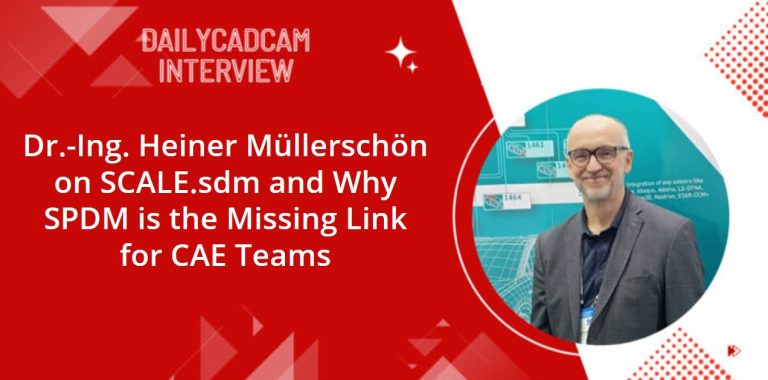
该采访于 SIAT Expo 2026 在印度普纳期间进行。
这场为期三天的活动汇集了超过 250 场技术报告、主题演讲和由行业领先企业参与的展会——为讨论现代仿真流程的挑战提供了理想的平台。
DailyCADCAM: Heiner, it was great meeting you at SIAT 2026 in Pune. For our readers, can you tell us a little about SCALE and what you do?
Heiner Müllerschön: Yeah, sure. SCALE is basically all about simulation data management. That’s our core focus. Some people call it SDM and some call it SPDM, which is Simulation Process and Data Management. If you compare it to what most people already know, it’s similar to PDM systems. Everyone understands PDM – product data management – mainly for CAD data. And SDM is kind of the same idea, but dedicated to simulation data and simulation workflows. And for us, this is not one of many products – we are 100% focused on simulation data management. That’s the only thing we do.
DailyCADCAM: Honestly, I thought PLM and PDM already cover everything, including simulation. So is this really something separate?
Heiner Müllerschön: Yes, and that’s exactly the point. Most companies think PLM covers simulation, but in practice, it usually doesn’t. PLM and PDM are mainly optimized for CAD and design data. Simulation has different requirements. It’s not just storing files. Simulation work has processes, workflows, solver runs, iterations, results, reports, correlations, and different specialists working on the same product. That’s why SDM exists – it’s specifically built for simulation and test data and the processes around it.
DailyCADCAM: So, what is SCALE.sdm exactly? How would you describe it?
Heiner Müllerschön: SCALE.sdm is our platform for simulation and test data management. The simplest way to explain it is: it becomes the central hub for CAE engineers. You can organize, version, manage, analyze, and collaborate on simulation models and results in one connected system. It helps teams keep everything structured and traceable, so you don’t lose data and you don’t repeat work. And it’s not only about storage, it’s also about how simulation teams actually work day-to-day.
DailyCADCAM: What is the main purpose of the system for simulation engineers?
Heiner Müllerschön: Collaboration, definitely. That’s the biggest purpose. Simulation work is done by many people – crash, NVH, durability, CFD, thermal, safety – and very often these teams are spread across different locations worldwide. Without a proper SDM, people end up working in disconnected folders and local hard drives. With SCALE.sdm, teams can share data, work simultaneously, and still keep everything controlled, structured, and consistent.
DailyCADCAM: During our discussion, you mentioned many companies still don’t use SDM. Is that really true today?
Heiner Müllerschön: Yes, it’s still true. What we see is that a large part of the automotive industry – maybe around 80 % – does not use any dedicated simulation data management system. They might have PLM for CAD and product data, but simulation teams still work on desktops, hard disks, shared drives, and unstructured server folders. And the result is that over the years, companies lose valuable simulation knowledge. They cannot reuse results properly, they repeat simulations, they waste compute resources, and development becomes slower.
DailyCADCAM: That’s interesting. So, what kind of simulation data is typically stored in SCALE.sdm? Only results or complete models?
Heiner Müllerschön: It depends on the customer, but usually its simulation data starting from mesh data up to the full functional finite element model, including results and reports. You can store each component as a separate object, and then you can assemble those objects into a full model. There are many possibilities. Some customers also store corresponding CAD data, but most of the time it’s mainly simulation-focused, because that’s where the biggest challenge is.
DailyCADCAM: Is SCALE.sdm cloud-based?
Heiner Müllerschön: Yes, it can be. Some customers host it on-premise, some host it in the cloud. It really depends on what the customer wants and what their security policies are. But yes, cloud is possible, and actually it’s a native cloud installation. Cloud has many advantages, but some companies still prefer on-premise. We support both.
DailyCADCAM: What about integration? Can it work with tools from Siemens, Dassault, Synopsys, and other CAE solvers?
Heiner Müllerschön: Yes, that’s one of our strengths. SCALE.sdm is an open platform, so it’s tool-agnostic. You can integrate any solver, any preprocessor, postprocessor, or automation tool you want. This is very important for customers because engineers don’t want to change their tools. So when we implement SCALE.sdm, we usually take the existing tools and processes and integrate them into our platform. We don’t force customers to change everything.
DailyCADCAM: Which industries are using SCALE.sdm today?
Heiner Müllerschön: Mainly automotive. More than 90% of our customers are automotive. And that’s because automotive has huge simulation volumes and many engineers working on the same product. That’s where SDM brings the biggest benefit. But we also see aerospace and medical becoming more interesting, because simulation is growing fast in those industries too.
DailyCADCAM: SIAT 2026 had a strong automotive audience. How was the response at your booth in Pune?
Heiner Müllerschön: It was really good. We had a strong interest and demand. People were genuinely curious because simulation data management is still not widely known, especially compared to PLM. We also showcased our newest GenAI capabilities integrated into CAE workflows. The response was amazing because engineers today expect AI to help them find data faster, reuse knowledge, and improve productivity.
DailyCADCAM: Do you have customers in India already?
Heiner Müllerschön: Yes, we have one large customer in India right now – an automotive OEM in Bangalore. It’s a larger installation. We are just entering the Indian market, so this is the first step. But we are in discussions with other OEMs, and we hope to expand soon.
DailyCADCAM: Many engineering service providers support global OEMs. Do they also use your platform?
Heiner Müllerschön: Yes, typically the OEM has the enterprise installation and they collaborate with engineering service partners through the platform. The service providers use SCALE.sdm to work together with the OEM, share models, tasks, and results. This is a big advantage because OEMs can manage collaboration and control access through the system.
DailyCADCAM: Where is SCALE based, and how big is your team?
Heiner Müllerschön: The company is about 60 people. We do software development in Germany and also in India. We have a subsidiary in Jaipur, Rajasthan, and software is developed there as well. So it’s a combined development effort between Germany and India.
DailyCADCAM: What kind of training and support do you provide to customers?
Heiner Müllerschön: We provide training, of course. Usually we start with a one-day introduction training, mainly online. And then we support customers with installation, customization, consulting, and operations – whatever is needed. In general, the system is easy to use, and because it integrates with existing tools, the training requirement is not too heavy.
DailyCADCAM: Engineers are talking a lot about AI now. How does AI fit into simulation data management?
Heiner Müllerschön: AI becomes useful when your data is structured and accessible. If your simulation data is scattered across folders, AI can’t really help much. But when you have a data management system like SCALE.sdm, everything is in one place, structured, and traceable. Then you can apply AI methods. Some companies already have their own AI, and SDM makes it easier for them. And we also have integrated AI for certain purposes, and we are developing more.
DailyCADCAM: Do you plan to expand beyond automotive into aerospace, defence, or medical?
Heiner Müllerschön: Yes, absolutely. Aerospace and medical are very interesting. In India, you have large GCCs and centers where thousands of engineers work on simulation for aerospace and defense. Any organization with a lot of simulation, a lot of engineers, and a lot of data will benefit from SDM. The bigger the simulation volume, the bigger the benefit.
DailyCADCAM: Are you planning to appoint resellers or partners in India?
Heiner Müllerschön: Yes, we are looking for a partner in India, but nothing is finalized yet. We welcome companies and resellers working in simulation software to discuss partnership opportunities. India is huge, and partners can help us expand faster.
DailyCADCAM: Finally, what message would you like to share with our readers, mostly design and simulation engineers?
Heiner Müllerschön: My message is simple: start using a simulation data management system. Of course, I’d love if it’s SCALE.sdm – but even if it’s another SDM system, it doesn’t matter. The benefits are huge. It makes life easier. Yes, it takes some effort in the beginning because it changes the way you work. But once installed, it’s absolutely worth it.
DailyCADCAM: Thank you, Heiner, for your time and for sharing these insights with our readers.
Heiner Müllerschön: Thank you! It was a great discussion, and I’m happy to connect with companies and engineers in India who want to explore SDM.
SCALE 印度 联系人
@ Harsh Sharma
SCALE 印度 总经理兼执行董事